German-American Bund
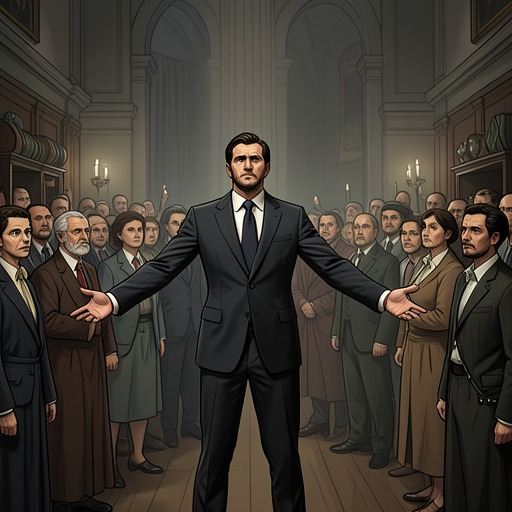
The Plot Against AmericaThe German-American Bund is a pro-Nazi, antisemitic organization that regains strength under President Lindbergh’s administration by presenting itself as patriotic and anti-Communist. Its near-capacity 1942 rally in New York exposes the tension between that revised public posture and its continuing hostility toward Jews, while making the organization a prominent point of conflict in the country’s political crisis.
Political rehabilitation
During Franklin D. Roosevelt’s second term, the Federal Bureau of Investigation and congressional committees investigated the German-American Bund, identified it as a Nazi front, and brought criminal charges against leaders in its high command. Under President Lindbergh, government efforts to harass or intimidate its members ceased. The organization was consequently able to regain strength, presenting itself as a patriotic association of German Americans opposed to foreign intervention and increasingly emphasizing its opposition to Communism.
That repositioning changed the public language around the organization without changing its underlying antisemitism. The German-American Bund equated Bolshevism with Judaism, singled out Jewish supporters of intervention—including Henry Morgenthau and Bernard Baruch—and continued to promote a vision of the United States ruled by Gentiles. Anti-Communism thus served not as a break with its earlier politics but as a patriotic frame through which its hostility toward Jews could be advanced.
The 1942 rally and its altered image
The organization filled Madison Square Garden with a near-capacity crowd of about 25,000 people. Those attending supported President Lindbergh’s invitation to the German foreign minister and condemned the Democrats for what they called renewed warmongering. The gathering demonstrated the German-American Bund’s ability to mobilize publicly after the investigations and prosecutions of the previous administration had weakened it.
The rally’s appearance differed sharply from the German-American Bund’s 1939 event. The earlier rally had displayed Nazi flags, swastika armbands, uniforms, a Hitler portrait, and banners attacking Jewish Communists. In 1942 those symbols and displays were absent. Their removal did not signal an abandonment of antisemitism: the organization continued to cast Jews as agents of Bolshevism and to advocate a Gentile-ruled country. The contrast shows how public presentation could be recast while the movement’s exclusionary purpose remained.
Opposition and political association
Walter Winchell continued to denounce the organization, using a mocking nickname for its members. Dorothy Thompson, who had been expelled from its 1939 rally after laughing at the proceedings, also persisted in criticizing its propaganda. Their opposition connected the German-American Bund’s public activity to a wider debate over whether President Lindbergh’s administration was allowing fascist politics to gain influence.
After the Garden rally, Democrats held a counter-rally at the same venue. Speakers attacked what they called the Lindbergh Bundists, and Franklin D. Roosevelt’s appearance drew a sustained ovation. The administration sought to distance itself from the German-American Bund’s gathering, but Democratic speakers deliberately associated the president with the organization’s discreditable reputation. The rally therefore became not only a demonstration of the organization’s regained capacity but also a political test of the administration’s relationship to it.
Echoes in the widening crisis
As Walter Winchell campaigned against fascism, his attempt to expose antisemitic organizations, including the German-American Bund, became a subject of debate among Jewish children in Newark: some questioned whether drawing such groups into public view would protect Jews or intensify the danger. In Boston, a mob that attacked Winchell carried handmade signs compared to those seen at the German-American Bund rallies. That resemblance links the organization’s public imagery to the atmosphere of intimidation surrounding Winchell’s campaign, but does not establish that the organization directed the Boston attack.
After violence in Detroit, Newark’s Jewish community prepared for possible attacks of its own. Community leaders organized civic consultations, while Longy Zwillman separately arranged for the Provisional Jewish Police to recruit local young men for neighborhood defense. These responses belong to the broader escalation of antisemitic violence in the novel; the evidence presents them as preparations against anticipated threats, not as actions caused solely by the German-American Bund. Together with the 1942 rally, they show how the organization’s anti-Communist patriotism coexisted with an antisemitic political climate in which Jewish citizens increasingly feared for their safety.